
What is an American? This question, and the debate surrounding it, has been in the zeitgeist of the United States for generations. Over a century ago, Theodore Roosevelt claimed that, “there is no room in this country for hyphenated Americans… if he is heartily and singly loyal to this Republic, then no matter where he was born, he is just as good an American as anyone else.” What Roosevelt is describing is an example of a “notional American,” someone who can be defined as an American, not by a shared history or ethnic background, but because they happen to believe in the right ideas. Ronald Reagan, over seventy years later, echoes similar thoughts. He famously said, “You can go to live in France, but you cannot become a Frenchman. You can go to live in Germany or Turkey or Japan, but you cannot become a German, a Turk, or a Japanese. But anyone, from any corner of the Earth, can come to live in America and become an American.” President Roosevelt’s disdain for so-called “hyphenated Americans” and President Reagan’s belief that “anyone can become an American” deny the existence of an American ethnicity. This argument can be easily denied by the mass migration that has occurred in recent years. Immigrants cling to their foreign ethnic identity with pride, still claiming to be members of their original nation. It is clear, despite Roosevelt’s protestations, that Americans can be defined by a single, shared ethnic background.
How then, in regards to ethnicity, should one refer to White heritage Americans? The easiest answer to this question, as many have argued, is simply the label “Anglo-American.” After all, the United States began as an English settler colony. The United States and England share a history, a language, and a similar Protestant identity. President Donald Trump, in remarks during Charles III’s visit to the US, denied the idea of notional Americans and referred to the “Anglo-Saxon courage” and “English faith” of the founders. While this answer is partially true, it is wholly insufficient. If one is to claim that Americans are exclusively a part of the English ethnicity, then some of the greatest Americans in history would be excluded from the label “American.” President Andrew Jackson was of Scottish descent, Eisenhower German, and Martin Van Buren’s family was originally Dutch. All of these men had lineages with a presence in America that predates the Declaration of Independence. It is clear, that at some point between the founding of Jamestown in 1607 and now, there became a distinct and original American ethnicity that appeared from a unique mixture of various Western European ethnic groups.
It may seem that defining an ethnic group as a mixture of other existing ethnic groups is a foolish notion, and there are plenty of people who think that. It is a common insult among white nationalists to pejoratively refer to Americans as “mutts” for having a number of different European heritages. But this is how nearly every ethnicity is initially defined. Take England, for example. Thousands of years ago, there was no such thing as an Englishman. The Anglo-Saxon identity came about many centuries ago from the Angles, the Jutes, and the Saxons, three related but distinct European tribes. Many years after that, the Normans invaded, and also embedded themselves into the English identity. Different Englishmen may have different percentages of Angle, Jute, Saxon, or Norman blood, but they are all considered Englishmen. It would be ridiculous to conclude that the English ethnic identity does not exist, or that Englishmen are mutts, and the same thing is true for the American.
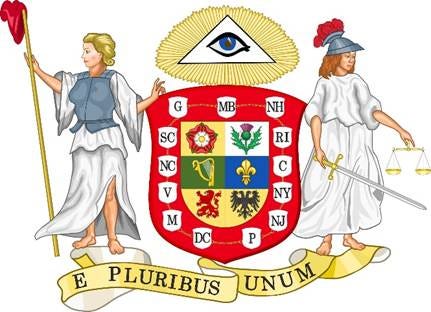
The Founding Fathers understood this concept. In August of 1776, during the Second Continental Congress, an original, American coat of arms (pictured below) was proposed to the body. In the center of the coat of arms were six symbols. These were national symbols associated with (listed from top left to bottom right) England, Scotland, Ireland, France, the Netherlands, and Germany. Although the design was ultimately rejected by the congress, what matters is the sentiment. Even as early as 1776, Americans saw themselves as the inheritors of a European identity. They were not wholly any one of those six ethnicities, but a unique blend. The Englishman came from the Saxons, Jutes, Angles, and Normans, and the American comes from the English, the Scots, the Irish, the French, the Dutch, and the German.
Great American leaders have supported this argument with their own words throughout history. John Jay, Founding Father and the First Chief Justice of the Supreme Court wrote in Federalist Papers No. 2, “With equal pleasure I have as often taken notice that Providence has been pleased to give this one connected country to one united people--a people descended from the same ancestors, speaking the same language, professing the same religion, attached to the same principles of government, very similar in their manners and customs, and who, by their joint counsels, arms, and efforts, fighting side by side throughout a long and bloody war, have nobly established general liberty and independence.” At first glance, it may seem that John Jay is referring specifically to the English people with his phrase “a people descended from the same ancestors.” After all, the “same language” he writes of is English. But John Jay was ethnically French from his father’s side and Dutch from his mother’s. If he was specifically referring to a shared English ancestry, or was only referring to one specific kind of European descent, then Jay himself would not be included in his own statement. Instead, by “the same ancestors,” Jay was referring to a shared Western European heritage that existed in America up until that point.
This idea should not, however, be confused with the “melting-pot” philosophy that has controlled American thought for over a generation. The heritage American is easily defined, as seen above. The ethnic label of American is distinct and exclusive. It does not include third worlders whose only claim to being an “American” is a bald eagle on the cover of a passport. While being American is not exclusive to being of English descent, it is exclusive to those of Western European descent. It would be preposterous to claim that someone from India could ever be as American as the Eisenhowers, Van Burens, and Jays. It is especially important, now more than ever, to be able to differentiate between the settlers whose presence in America predates the Declaration of Independence, and immigrants who subvert our society, and have no ancestral claim to being here.
It must also be noted that while American identity is distinct from an English identity, there is a great level of kinship that exists between the two peoples. America remains more closely related with England, and the greater Anglosphere, with regards to culture, language, and religious practices than any other country in the world. President Trump’s remarks about the shared heritage between the two people is not wrong, the relationship is merely more complex than it may seem. A Prussian is a German and a Bavarian is a German, but a Prussian is not a Bavarian. In the same manner, an Englishman is not an American and an American is not an Englishman, but they both belong to the greater Anglosphere.
Why is a strongly defined ethnic identity important for Americans? It appears, at first, to be an argument for pedants. It is important because the enemies of America must first deny the existence of an American people. In their fight for increased immigration, America’s opponents will claim that the Americans who predate the Constitution are the same as immigrants who arrived here yesterday. If there exists no American heritage, then there is no difference between John Jay, a non-Englishman, and a Somalian. If there exists no ethnic American, then this country is nobody’s birthright, and it can be looted and pillaged until there is nothing left. The maintenance and protection of America falls on those who are of American heritage. Sometime in the four-hundred-and-nineteen years since the founding of Jamestown, the American ethnicity was born, and the United States of America belongs to its people, not to the world.
Thank you for reading.
Post Script: Although the purpose of this article was to define White Americans, I would be remiss if I did not mention, at least once, the term “African American.” The African American, much like the White American, has existed in America for centuries and also predates the Declaration of Independence. The term was initially used to refer to the descendants of slaves and freedmen originally brought to America from West Africa, but has been used, on many occasions, to refer to any Black person living in America. This second definition is something I would like to contend. Where an African American has ancestral roots in America, an African immigrant, from Somalia, for example, does not. It would be a disservice to the true African Americans for those two people to fall under the same umbrella.