
Earlier this week, the Commonwealth of Virginia held a referendum for the state’s voters to decide whether or not to approve a new redistricting plan. This plan, proposed by Virginia Democrats, would give the Democratic Party a significant advantage in future elections, as it would divide the blue suburbs of Washington D.C. among a number of districts, thereby turning those districts blue. The proposed map, from CBS News, can be seen below. The Virginia vote was a close one; at the time of writing, the results are 51.5% in favor and 48.5% of voters opposed. According to political analysts, this new map would give Democrats an advantage in 10 House districts, and they could pick up as many as 4 new seats in the House. The results of the referendum paint Virginia as being a purple state, with Democrat voters holding only a slight majority. However, the new map would cause the Republican voters to be significantly underrepresented.
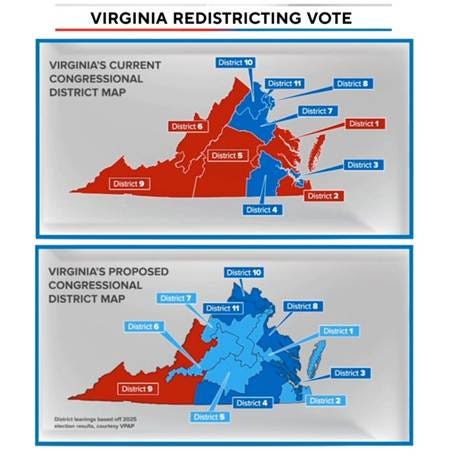
Where Republicans across the nation lament over the loss, the Democrats celebrate. This conflict is a curious thing, because in other states with similar attempts, the Democrats were the ones to protest, calling the proposed maps “gerrymandering.” (The 2025 Indiana redistricting is a great example of this, and will be elaborated upon later.) Former President Barack Obama himself has given seemingly conflicting statements. On July 8, 2020 he tweeted, “For too long, gerrymandering has contributed to stalled progress and warped our representative government. Redistricting begins next year—let’s all do our part to protect and restore our democracy.” But by April 21st of 2026, he seems to have changed his mind. He applauds the passing of the referendum, tweeting, “Congratulations, Virginia! Republicans are trying to tilt the midterm elections in their favor, but they haven’t done it yet. Thanks for showing us what it looks like to stand up for our democracy and fight back.” So, which is it? Is the former President a massive hypocrite? Are members of both American parties massive hypocrites? No! Obama is not celebrating the continuation of the American legal system against lawlessness and deception; he is celebrating a moral victory, not a constitutional victory. As the American political system stands in the year 2026, this discrepancy can be seen everywhere. Arguments about whether or not something is legal are overridden by arguments about whether or not something is moral. Opinions on the Constitution have been warped. The American people no longer see it as providing a legal framework for the political system, but instead as a tool to get what they want, or an obstacle that needs to be dismantled.
The Supreme Court decision in Roe v. Wade in 1973, and its eventual overturning in Dobbs v. Jackson Women’s Health Organization in 2022 provide a great illustration to this point. The actual legal arguments in favor of abortion rights in Roe were tenuous. The Court held that Due Process Clause in the Fourteenth Amendment maintained a “right to privacy” and the right to an abortion fell within those rights. Despite the questionable reasoning behind the decision, pro-abortion advocates celebrated. These advocates were not celebrating the brilliant case law and fantastic reading of the Constitution by Justice Blackmun, they were celebrating a moral victory, and the furtherance of their goals.
Readers who believe in a women’s right to an abortion would scoff at calling the justification for Roe v. Wade tenuous. It would seem that by questioning the legal basis for the decision, one was arguing that abortion was a moral failing. It is possible that some readers would stop reading as soon as the word “tenuous” was used at all. But that is exactly the point. By criticizing the legal basis of the decision, it seems as if the moral basis of the decision is being criticized. It would be a monumental challenge to find an American in 2026 saying, “Well I’m all for a women’s right to an abortion, I just wish we went about it in a better way.” A similar reaction, in the opposite direction, can be seen in the overturning of Roe v. Wade in 2022 by the decision in Dobbs v. Jackson Women’s Health Organization. Once again, when the decision was made, pro-lifers were not applauding for the great and noble defense of the Constitution. They were applauding because abortion rights had suffered a major blow.
The barrier between what is Constitutionally permissible and what is morally permissible used to exist, and has dissolved relatively recently. There is a major disconnect in the actions of politicians and the expectations of their constituents. This division is much more prevalent in the Republican party, where some politicians tend to cling to what is “fair” and “constitutional” rather than what advances their position. In late 2025, a bill was presented to the Indiana State Congress that would redraw the state’s congressional districts in such a way that heavily favored the Republican Party. To put it succinctly, it would do for Republicans what the recent Virginia redistricting did for Democrats. Although it passed in the State House of Representatives, when it came time for the Senate vote, Republican lawmakers quailed. Despite having a supermajority in the Senate, Republicans failed to pass a bill that would heavily favor them. The 21 Republicans who opposed the bill were more concerned with supposed fairness than securing a solid victory for their party. There was an outcry among many Republicans that obviously remained unheard.
Adherence to constitutionality has proved to be a stumbling block for the Republican Party on more than one occasion, with another notable case being the arguments relating to birthright citizenship. Where President Trump and Solicitor General D. John Sauer believe that ending birthright citizenship is a moral imperative for the betterment of the United States, the justices seem to only be concerned with what the Constitution says. When Sauer argued that the prevalence of “birth tourism” increased as transportation became more accessible, Chief Justice John Roberts retorted, “Well, it’s a new world. It’s the same Constitution.” Roberts’ statement was the most scathing opposition to Sauer’s arguments, but he was not alone. Justice Thomas and Justice Barrett had their doubts as well.
One might expect these justices to side with Trump on anything. After all, they were nominated by Republican Presidents, and should have Republican views. Obviously, this is a foolish assumption, as a Supreme Court Justice would be concerned with the Constitution above everything else. Right? Maybe not. Despite the aforementioned case of Dobbs v. Jackson Women’s Health Organization being a proverbial “slam dunk” in terms of constitutional law, Justices Breyer, Sotomayor, and Kagan all dissented to the opinion. The justification for the original decision may have been flimsy, but those three Justices remained loyal to the party of the Presidents that had nominated them. The Constitution did not matter. What mattered was siding with their own party on an important issue. These particular Justices may argue with that assertion but Justice Jackson, a Biden appointee, outright admits it. In what may be the greatest written opinion in the history of the US Supreme Court, Jackson, in her dissent in Trump v. Casa, states, “A Martian arriving here from another planet would see these circumstances and surely wonder: ‘what good is the Constitution, then?’ What, really, is this system for protecting people’s rights if it amounts to this…” Justice Jackson is more concerned with what she sees as protecting people’s rights, instead of the Constitution.
The Republican Party, in its neutered state, will respond to the Democrats with accusations of hypocrisy. But the attitude of the Democratic Party is not hypocritical at all. The Democratic establishment and its associates, like Justice Jackson and the Martian from another planet, have never claimed to care about constitutionality. They will outright say it. The adherence to the Constitution by Republicans is a major stumbling block in progressing the interests of the American right. Republicans have failed to secure multiple states, and have failed to end birthright citizenship. There are many members of the Republican establishment who would claim that this is a good thing. That it is better to be a principled loser than to be a hypocritical winner. It is better to die with clean hands than to live with dirty ones. But this can not be the case. As written earlier, the Democrats are not hypocrites. They do not believe in a constitutional framework, and they have never claimed to believe in it. Democrats do adhere to their principles; their principles just differ from the Republicans. For the Republican Party to have any future in the United States, they must change their principles, as the Democrats have. It may be better to be a principled loser than a hypocritical winner, but it is certainly better to be a principled winner than a principled loser.
Thank you for reading.